
University of Mataram Strengthens Participatory Governance Through Elected Representation and Institutional Participation
The University of Mataram (Unram) applies representative and participatory principles in its institutional governance through elected academic representatives in the University Senate and Faculty Senates, complemented by the participation of students and non-academic staff in institutional committees, quality-assurance mechanisms, and campus governance structures. These arrangements contribute to Sustainable Development Goal 16 (SDG 16): Peace, Justice and Strong Institutions, particularly Indicator 16.2.1, which concerns elected representation and participation in university governance.

The University Senate as the Highest Normative and Representative Body
The University Senate of the University of Mataram is described by the University as the highest normative and representative body of the university. Its membership includes professors, university leaders, deans, and lecturer representatives, providing academic staff with formal representation in the University’s highest representative governance structure. The Senate carries important institutional responsibilities, including formulating academic policy, establishing academic norms and standards, providing consideration on University development, reviewing University budget proposals, and evaluating the accountability of University leadership. This structure ensures that major academic governance decisions are not made exclusively by executive leadership but also involve representatives of the University’s academic community.
Academic Representatives Are Chosen Through Elections
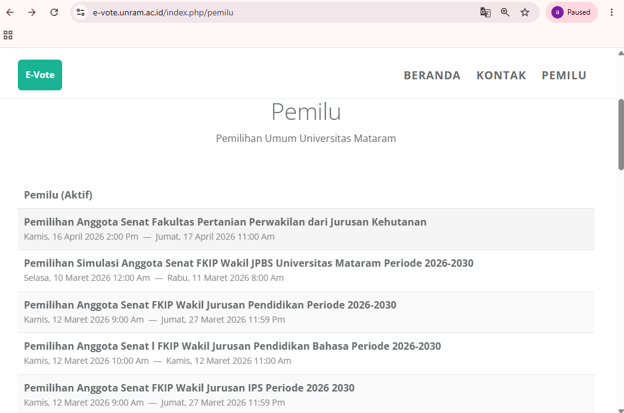
Representation within the Senate is supported by a formal electoral process. The University’s official electronic voting platform documents a series of Senate elections, including elections for lecturer representatives, professor representatives, Faculty representatives, and the Chair of the University Senate. During 2025, the electronic voting system recorded elections including the University Senate lecturer representative from FHISIP, professor representatives, representatives from the Faculty of Engineering and Faculty of Agriculture, FKIP Senate representatives, and the Election of the Chair of the University Senate for the 2025–2029 period. The use of an electronic voting system strengthens transparency and accountability by providing a structured mechanism for eligible members of the University community to participate in representative selection.
Faculty-Level Democratic Representation
Participatory governance also operates at Faculty level through Faculty Senates. In September 2025, the Faculty of Economics and Business conducted a democratic election of Faculty Senate members involving representatives from academic units across the Faculty. Candidates came from different academic backgrounds and study programmes, enabling diverse expertise and perspectives to be represented in Faculty governance.
Faculty Senates provide academic consideration, contribute to policy direction, and support quality assurance in education, research, and community service. The formalisation of this process has been further strengthened through Rector Regulation No. 4 of 2026 on the procedures for the election, appointment, and dismissal of Faculty Senate members. This regulatory framework demonstrates that representative governance is embedded within formal University procedures rather than relying solely on informal arrangements.
Representation of Lecturers in University Governance
The strongest evidence for Indicator 16.2.1 at Unram is the elected representation of academic faculty members. Lecturers and professors participate directly in selecting representatives to University and Faculty Senates, and elected representatives contribute to institutional decision-making on academic standards, University development, quality assurance, and leadership accountability. The University Senate structure explicitly includes lecturer representatives as part of the University’s highest normative and representative body. This creates an institutional pathway through which academic staff can contribute to governance beyond their individual departments or study programmes.
Participation of Non-Academic Staff in Institutional Governance
Non-academic employees also participate in governance and institutional decision-support mechanisms, although their participation is not presently documented as elected membership of the University Senate. One example is the University’s Task Force for the Prevention and Handling of Sexual Violence, which incorporates representatives from multiple components of the University community.
The University has publicly confirmed through its description of the Unram Sexual Violence Prevention and Response Task Force that the Task Force includes students, lecturers, and educational or administrative staff. This multi-stakeholder composition enables non-academic employees to participate directly in institutional mechanisms related to campus safety, protection, reporting, prevention, and accountability. Staff participation is also visible in Faculty governance and management processes. University units regularly involve heads of administration, quality-assurance personnel, laboratory coordinators, and other professional staff in institutional planning, review, and evaluation.
Student Representation in Institutional Governance
Students also participate in institutional governance through University and Faculty structures. Their participation is particularly visible in institutional committees concerned with student welfare, safety, and quality assurance. Through the University’s Sexual Violence Prevention and Response Task Force, student representatives work together with lecturers and non-academic staff in implementing prevention, reporting, response, and campus-safety mechanisms.

This arrangement gives students a formal role in an institutional body whose decisions and activities directly affect the University community. Student participation is also incorporated into quality-assurance processes. Faculty Quality Assurance Groups collect student input as part of monitoring and evaluating educational quality. For example, the Faculty of Food Technology and Agroindustry Quality Assurance Group explicitly involves students in evaluating teaching and learning processes, ensuring that student perspectives contribute to recommendations for academic improvement. Furthermore, active student participation in governance and academic decision-making is also evidently demonstrated in the strategic formulation of the New Vision of the Food Science and Technology Study Program 2025.
Student Voice in Quality Assurance
Quality assurance provides another important pathway for participatory governance. The University of Mataram includes stakeholder surveys covering students, lecturers, partners, and graduate users, and uses these inputs to support monitoring, evaluation, internal quality audits, and management reviews. At Faculty level, Quality Assurance Groups coordinate internal quality systems and evaluate whether educational standards are being achieved. Student feedback therefore contributes directly to institutional evaluation and continuous improvement through the University’s PPEPP cycle — Establishment, Implementation, Evaluation, Control, and Improvement. Although this form of participation differs from elected Senate representation, it ensures that students have structured opportunities to influence educational quality and institutional improvement.
Undergraduate and Postgraduate Participation
University governance mechanisms serve a community that includes both undergraduate and postgraduate students. Student participation occurs through student organisations, quality-assurance activities, surveys, committees, academic forums, and institutional task forces. At the postgraduate level, students are similarly included within academic evaluation and programme-level quality-assurance mechanisms. Their feedback contributes to curriculum evaluation, student services, learning quality, research support, and academic governance.
However, the currently published University Senate composition does not explicitly list undergraduate or postgraduate students as members of the University Senate. For SDG reporting, it is therefore important to distinguish between elected membership of the highest representative body and student participation in wider University governance structures.
Transparent Election Through the University E-Voting System
The University’s digital election system provides particularly strong evidence of democratic procedures. The Unram E-Voting platform records elections not only for University and Faculty Senate representatives but also for leadership positions and student organisations. The system records, among other processes, elections for lecturer Senate representatives, professor representatives, Senate chairs, programme leadership, and student-association elections. This use of digital voting supports principles of transparency, accessibility, accountability, and verifiable participation in University decision-making.
Participatory Governance Beyond Formal Representation
Participatory governance at Unram therefore operates through several complementary mechanisms. Elected academic representation is formalised through the University Senate and Faculty Senates. Non-academic staff participation occurs through institutional committees, task forces, administration, quality assurance, and management processes. Student participation is incorporated into campus-safety bodies, student organisations, quality assurance, programme evaluation, surveys, and other institutional mechanisms. These structures enable different groups within the University to contribute to policy, institutional improvement, campus safety, academic quality, and organisational development.
Strengthening Accountability Through Representation
The representative functions of the University Senate are particularly important for ensuring checks and balances within institutional governance. The Senate’s responsibilities include consideration of academic policies and norms as well as evaluation of University leadership accountability. These functions create a mechanism through which elected academic representatives can participate in institutional oversight rather than leaving governance entirely in the hands of executive leadership. At Faculty level, elected Senate representatives perform similar academic oversight and advisory functions. This multi-level system supports institutional accountability while recognising that universities require participation from diverse academic communities in determining their future direction.
Supporting SDG 16 Through Inclusive and Participatory Governance
The University of Mataram demonstrates a commitment to representative and participatory governance through elected Senate representation, transparent electronic voting, Faculty Senate elections, staff involvement in institutional committees, student participation in University task forces, and stakeholder involvement in quality assurance. The strongest direct evidence for SDG Indicator 16.2.1 is the elected representation of lecturers and professors within the University Senate, which Unram officially identifies as the University’s highest normative and representative body. At the same time, students and non-academic staff participate in a wider range of institutional governance and quality-assurance structures.
For accurate SDG reporting, these mechanisms should be distinguished clearly: academic faculty members have documented elected representation in the University Senate, while students and non-academic staff have documented participatory representation in other University governance bodies and institutional mechanisms rather than currently documented elected seats in the University Senate itself.
The University of Mataram maintains elected academic representation in its highest normative and representative body through the University Senate, supported by democratic Faculty Senate elections and an electronic voting system. Non-academic staff and students participate in institutional governance through multi-stakeholder task forces, quality-assurance processes, committees, and other representative mechanisms.