Mataram, Indonesia – The University of Mataram, a higher education institution committed to realizing the Three Pillars of Higher Education (Tridarma Pendidikan Tinggi), provides broad, equitable access to high‑quality education and teaching. To fulfill this mission, the University of Mataram has implemented policies to ensure that everyone, regardless of age, religion, ethnicity, race, gender, disability status, socio‑economic background, or education level, has access to lifelong learning resources. This commitment is enshrined in:
- Rector’s Regulation Number 4 of 2020 concerning Academic Ethics and the Code of Ethics
The regulation reflects Unram’s commitment to quality education and to sharing knowledge openly with communities beyond the campus. Lecturers are expected to carry out community service professionally and responsibly. This service should address real community needs, value community participation, and bring practical benefits drawn from their expertise. They must report the results to the Institute for Research and Community Service (LPPM). Fictitious community service is prohibited. Lecturers are also strictly forbidden from charging unlawful fees of any kind, and violations carry severe disciplinary sanctions. This keeps educational services free from improper charges. In addition, lecturers must remain open and accountable for their research findings. Together, these rules form the ethical foundation for Unram’s efforts to give the public free access to educational resources. The regulation further requires everyone on campus to treat others fairly and without discrimination based on ethnicity, religion, race, or social status, and it prohibits conduct that violates law, religion, or local custom. Faculty and university Ethics Councils enforce these standards, so every member of the Unram community can learn and work in a fair, respectful, and safe environment.
-
Rector Regulation Number 12 of 2019 concerning the Implementation of the Online Learning System (SPADA) at the University of Mataram
Library Open to General Public
The Unram Library (UPA Perpustakaan) accepts members from outside the academic community. Members only need to show an identity card (national ID card, driver’s license, or a student card from another university) and a 2×3 photo to register. Once registered, members can borrow textbooks, use the collections and electronic equipment in each service room, and receive guidance on information searching from librarians. Members can also access the internet in the service rooms and the library area Wi-Fi network.
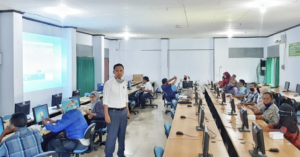
The library provides a multimedia room open until 10 p.m., an internet room, and special information corners such as the Tax Center and the World Bank Regional Information Outlet (RIO). At the faculty level, the Faculty of Teacher Training (FKIP) Library also welcomes visitors from outside FKIP to read on site after registering.
Sources: Unram Library User Guide, Unram Library Facilities, FKIP Unram Library
Journal and Repository Open at No Cost
Anyone can read research by Unram lecturers and students online at no cost. Unram journals are managed under an open access system through the Journal UNRAM portal, so members of the public, teachers, and researchers from other institutions can read and download articles as PDFs. FKIP Unram manages several open access journals through the FKIP Journal Portal, including Jurnal Pijar MIPA, Jurnal Biologi Tropis, and SOCED SASAMBO. The Postgraduate Program also publishes the Jurnal Penelitian Pendidikan IPA and other freely accessible journals. In addition to journals, Unram provides an Institutional Repository (eprints). Users can search for scholarly works by title, author, year of publication, subject, and study program. The Unram Library has also published access guides for the repository and the journals so the public can use them easily.
Digital Learning Resources for Remote Schools
Unram also brings its learning resources to schools with limited facilities. Through the Mathematics Education and Applied Mathematics Expertise Group, an Unram team built a website-based Mathematics Learning Resource Center (PSB Matematika) for teachers in the Suntalangu school cluster, Suela District, East Lombok. Unram’s DIPA BLU budget funds the program. One target school, SDN 4 Suntalangu, serves 150 students but has no library or laboratory. The PSB Matematika platform contains visual simulations of geometry and algebra, learning videos, self-study modules, and gamified practice questions. Teachers and students can use it without depending on the school’s physical facilities. The Unram team trained 20 classroom teachers to use the platform. The Unram team also facilitated a Teacher Working Group (KKG) network so teachers can keep sharing materials and good practices after the program ends.
Sources: RRI Mataram
Supporting Quality Education for All
Opening this access aligns with the Sustainable Development Goals (SDGs), particularly SDG 4 (Quality Education). This goal promotes lifelong learning opportunities for everyone, including those not currently enrolled in higher education.
With a library that accepts public members, open journals and a repository, and digital learning platforms for partner schools, Unram ensures that the knowledge produced on campus can benefit the wider community. This effort also supports SDG 10 (Reduced Inequalities) by narrowing the gap in access to learning resources between urban and rural areas in NTB.