University of Mataram Expands Public Access to Exhibitions, Visual Arts and Cultural Heritage Dialogue
The University of Mataram (Unram) continues to connect academic creativity with wider public audiences through exhibitions, performances, and cultural knowledge exchange. During 2025 and the first half of 2026, the university documented activities that opened opportunities for members of the public to encounter student photography, film-related artwork, literary creations, and other displays beyond regular classroom settings. These initiatives contribute to Sustainable Development Goal (SDG) 11, particularly Indicator 11.2.3, which concerns public access to museums, exhibition spaces, galleries, works of art, and artifacts.
The clearest evidence of public-facing exhibition activity comes from Unram Impact Expo 2025, held at Lombok Epicentrum Mall on 29 November 2025, and an arts showcase held at Unram’s Arena Budaya on 23 June 2026. The university was also represented in a 2025 academic discussion concerning the development of thematic museums in West Nusa Tenggara (NTB). Together, these activities demonstrate active exhibition-based public engagement and support for cultural infrastructure planning, while the evidence must be distinguished from ownership or operation of a permanent public museum by Unram.

Opening a Public Exhibition Space for Student Photography and Visual Arts
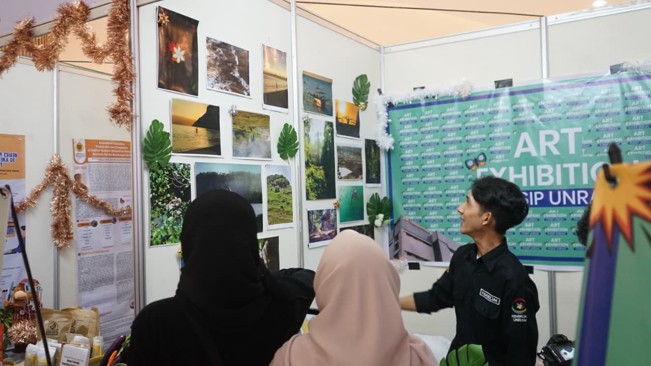
On 29 November 2025, the Faculty of Law, Social Sciences and Political Science (FHISIP) presented a visual arts exhibition as part of Unram Impact Expo at the ground-floor atrium of Lombok Epicentrum Mall. According to the official University of Mataram report, the exhibit brought together 42 student photographs and five film posters, alongside film trailers displayed at the exhibition booth. The works focused on environmental issues and were intended to encourage public awareness of the importance of protecting the natural environment.
The selection of a shopping mall atrium enabled the exhibition to reach visitors outside the university community. A visitor interviewed in the report described the value of seeing the faculties’ outputs directly, including FHISIP’s photography. In this setting, visual artworks served not only as student assessment outputs but also as publicly viewable objects through which environmental ideas could be communicated and discussed.
The exhibition is especially relevant to Indicator 11.2.3 because it provides documented evidence of artworks being displayed in a public-facing exhibition space. Its contribution should be reported as event-based public access to a university-organized exhibition, rather than as evidence of a permanent university gallery. Maintaining attendance records, exhibition inventories, visitor photographs, and future event schedules would help substantiate the reach and continuity of such access.
Bringing University Research and Creative Works into a Community Exhibition Venue
The wider Unram Impact Expo 2025 provided a public exhibition platform for research outputs, faculty projects, and innovative student work. The official university account explains that the event brought together faculty booths, discussions with academics and practitioners, interactive programmes, and opportunities for people outside the university to examine displayed work. By taking the event to Lombok Epicentrum Mall, Unram made a broad range of academic and creative outputs visible to the wider community.
The event was not limited to technology demonstrations or scientific displays. University reporting describes performances by the student arts and culture unit, including percussion, traditional dance, music, and solo singing, complementing the visual and research exhibitions. This combination enabled visitors to engage with different forms of artistic expression and university-produced works in a common public venue.
The Faculty of Economics and Business also participated in the expo by presenting student-produced creative and tourism-related products. Its official account notes that local and international visitors interacted with the exhibits and learned about the faculty’s educational activities. These examples reinforce the role of temporary exhibitions as accessible interfaces between university achievements and the public, although they are not evidence of an institutional museum collection.

Providing Free Public Access to Arts and Displays at Arena Budaya
On 23 June 2026, students of the Indonesian Language and Literature Education programme (Bastrindo), Faculty of Teacher Training and Education (FKIP), organized an Inspirational Works Showcase at the University of Mataram’s Arena Budaya. An event report published on 24 June 2026 states that the programme began at 09:00 WITA and was open to the public free of charge. The event combined coursework from Performing Literature, Introduction to Education, and Journalism into a public presentation of student work.
The activities included shadow-puppet performances, theatrical poetry, and an exhibition of magazines produced by students. The magazine exhibition is directly relevant to the provision of public access to creative works, while the performances extended the cultural encounter beyond static displays. Opening the event without an admission charge allowed community visitors to appreciate university-produced artistic and literary content within a campus cultural venue.
This event demonstrates the use of Arena Budaya as a space that can host public exhibitions and cultural programming. However, a dated public event does not establish that the building functions as a permanently open gallery or that the university maintains unrestricted visiting hours for the public. To support future reporting, Unram could publish a clear public-use schedule, visitor arrangements, and a programme of recurring exhibitions featuring student work and regional cultural artifacts.
Contributing Academic Expertise to the Development of Thematic Museums in NTB
The University of Mataram’s links with the wider museum sector were also visible in a 2025 discussion about creating thematic museums in West Nusa Tenggara. On 9 September 2025, Museum Negeri NTB held a meeting on the preparation of an academic manuscript following an earlier focus group discussion about proposed thematic museum development. The museum’s official news portal records the participation of Unram academic Prof. Dr. Nuriadi Sayif alongside representatives of the provincial development team, cultural institutions, historians, and other scholars.
The discussion considered a proposed thematic narrative titled “Traces of Eruptions and the Sea: The Samalas-Rinjani and Tambora Heritage in NTB Culture.” Participants considered how geology, historical events, and community adaptation could be presented through museum narratives and audiovisual interpretation. This academic involvement links the university’s expertise in culture and the humanities to discussions on expanding access to heritage interpretation in the region.
The meeting should be characterized accurately as participation by a Unram scholar in a museum-development discussion, not as proof of a new institutional memorandum of understanding between Unram and Museum Negeri NTB in 2025. The proposed museum was still in a planning and academic formulation stage during the documented event. Even so, the participation illustrates a meaningful channel through which university expertise can contribute to the design of future public cultural spaces.

Connecting University Cultural Spaces with Wider Regional Museum Development
In June and August 2025, Museum Negeri NTB publicly described plans to develop thematic museums that could make regional heritage more accessible and engaging. The museum proposed presenting cultural material through focused themes rather than relying exclusively on conventional permanent collections. Its planning discussions highlighted the need for public learning spaces that communicate the cultural history of the region in ways relevant to younger generations and visitors.
Unram’s public exhibitions and the September 2025 participation of one of its academics demonstrate two complementary pathways for supporting this broader cultural access agenda. Temporary university-run exhibitions provide opportunities for the public to view new creative work, while academic dialogue contributes expertise to future museum planning. Together, these activities can promote wider public engagement with creative expression and heritage, but formal museum ownership, joint curatorial operations, or guaranteed museum access cannot be inferred from them.
The potential use of Arena Budaya for recurring exhibition programmes represents an opportunity for further institutional development. Dedicated display areas, published access conditions, visitor information, and documentation of displayed works would make the public-service function of this venue more visible and measurable. Any permanent university museum or gallery should only be reported as operational after its establishment and public access arrangements have been formally documented.
Advancing SDG 11 Through Public Exhibition Access and Cultural Collaboration
The University of Mataram’s activities during 2025 and the first half of 2026 show documented participation in public exhibitions and cultural knowledge exchange. The November 2025 photography and visual arts display created direct access to university-produced artworks at a public commercial venue, while the June 2026 Arena Budaya showcase provided free access to student literary and artistic presentations. Academic participation in NTB’s thematic museum planning discussions further demonstrates the university’s connection to regional cultural infrastructure development.
These activities support SDG Indicator 11.2.3 most clearly through temporary exhibitions and public access to works of art. The evidence does not yet demonstrate the existence of a permanent university-operated museum or a continually open gallery, and the museum-sector engagement documented in September 2025 should not be presented as a signed 2025 partnership agreement. Clear reporting of exhibition dates, public access conditions, visitor participation, photographs, and any formal museum cooperation documents would strengthen the university’s future evidence for the indicator.
By continuing to provide accessible opportunities to view creative works, and by participating in the exchange of expertise on cultural heritage presentation, Unram can contribute to a more inclusive cultural landscape in Mataram and West Nusa Tenggara. These efforts complement the university’s academic mission and its commitment to sustainable communities. Continued collaboration with cultural institutions and regular public programming can expand the visibility and educational benefits of exhibitions, arts, and regional heritage.
INSTITUTIONAL POLICY CONTEXT
The University of Mataram Rector’s Decree No. 5157/UN18/HK/2026, dated 6 April 2026, states institutional commitments concerning the preservation of cultural and environmental heritage and the provision of public access to designated university resources in accordance with applicable provisions. These commitments provide a broader policy context for exhibition-related public engagement. They do not, by themselves, certify that a dedicated university museum or gallery was operational during the 2025–June 2026 reporting period.